I Donated An Old Coat. Then A Woman Called Me Because She Found A Secret In The Lining…
The Coat I Forgot I Owned
I found the coat buried in the back of my hall closet during one of those cleaning frenzies you get when you’re avoiding something else. It was wool, charcoal gray, and I honestly couldn’t remember the last time I’d worn it.
Maybe when the kids were in middle school? That would put it at twenty-five, thirty years old. The lining had that musty smell of storage, but the coat itself was still in decent shape. I figured someone at Goodwill could use it more than I could.
I’m sixty-one now, and I’ve been trying to simplify things. Fewer things to dust, fewer things to remember. I tossed the coat into a donation bag along with some sweaters and a pair of boots I’d never liked.
Dropped the whole lot off on a Tuesday afternoon, felt that tiny spark of satisfaction you get from being productive. I didn’t check the pockets. I didn’t run my hands along the lining. I just let it go.
A week later, I got a message on Facebook from someone I’d never met. Her name was Hannah, and she said she’d bought my coat at the thrift store. She said she found something inside it, something I probably wanted back.

Image by RM AI
The Message from a Stranger
Hannah’s message was polite, almost apologetic. She explained she’d bought the coat because it fit her perfectly and the price was right. When she got home, she noticed a strange bulge in the lining near the hem.
She thought maybe it was just bunched-up fabric, but when she squeezed it, she felt something hard. She wrote that she didn’t want to pry, but she thought I should know. I messaged her back immediately, asking what she’d found.
She replied within minutes. ‘It’s a small brass key,’ she wrote. ‘There’s a number stamped on it. 612.’ My chest tightened. I stared at that number on my phone screen until the letters blurred. I asked her if she could send a photo. She did.
The key was old, tarnished around the edges, with that number etched clearly into the brass. I hadn’t seen that key in decades, but I knew exactly what it was.
It belonged to a safety deposit box at the bank my mother used, the one we’d closed out after she died. At least, I thought we’d closed it.
But there it was, staring back at me from a stranger’s hand, like it had been waiting all this time for someone to find it.

Image by RM AI
The Number I Knew Too Well
I sat at my kitchen table with my phone in my hand, zooming in on that photo until the number filled the screen. Box 612. My mother had rented it sometime in the seventies, back when she still handled her own finances.
After she died in 1993, my siblings and I had gone through the probate process in a fog. Everything from that time felt like it happened underwater. There were so many papers to sign, so many offices to visit.
I remembered going to the bank with my brother. We’d met with someone, a manager maybe, and he’d walked us through closing the box. I was sure we’d emptied it. There were a few bonds, some old jewelry, nothing remarkable. We signed forms.
We handed back the key. At least, I thought we did. But now I was holding a phone with a photo of that same key, and I couldn’t remember who had actually turned it in. Maybe no one did.
Maybe it had been in my coat pocket all along, slipped into the lining somehow, forgotten for three decades. But why would I have kept it? And if the box was closed, why did the key still exist?
I sat there, staring, and a cold unease settled over me. Something about this didn’t add up.

Image by RM AI
Meeting in a Parking Lot
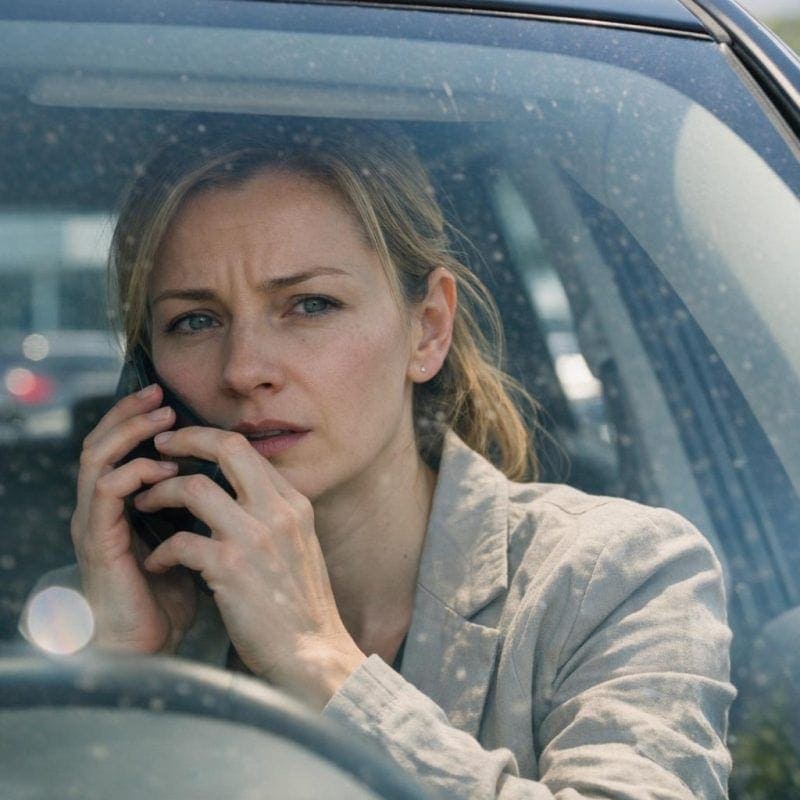
Hannah and I arranged to meet the next day in the parking lot of a coffee shop halfway between us. She was younger than I expected, maybe mid-thirties, with kind eyes and an nervousness that made me feel bad for dragging her into whatever this was.
She handed me a small zippered pouch. ‘I put it in here so it wouldn’t get lost,’ she said. I thanked her, and she smiled, but then she hesitated. ‘Can I ask you something?’ she said. I nodded.
‘The key was taped inside a hidden pocket in the lining. Like, sewn in behind the regular pocket. I only found it because the stitching had come loose.’ I felt my stomach drop. ‘A hidden pocket?’ She nodded. ‘Yeah. It wasn’t just tucked in there.
Someone put it there on purpose.’ I looked down at the pouch in my hands. My voice came out quieter than I intended. ‘I don’t remember doing that.’ Hannah shifted on her feet. ‘Well, I’m glad I could get it back to you,’ she said.
She looked relieved, like she was happy to be done with it. I wished I could feel the same. Instead, I stood there in that parking lot, holding a key that had been deliberately hidden, and I had no idea who had put it there or why.

Image by RM AI
The Manager Who Looked Afraid
I went to the bank the next morning, key in hand, trying to keep my expectations low. Maybe the box had been emptied and they’d just forgotten to destroy the key. Maybe this was all a bureaucratic mix-up.
I showed the key to the teller, a young woman who looked at it with polite confusion. ‘Let me get the manager,’ she said. She disappeared into the back, and a few minutes later, a man in his late fifties emerged.
His name tag read ‘Mr. Devlin, Branch Manager.’ He looked at the key I held out, and I watched his expression shift. It wasn’t confusion. It was recognition. And something else. Something that looked a lot like concern. ‘Ms. Marsh?’ he said.
I nodded. He glanced around the lobby, then back at me. ‘Would you mind stepping into my office for a moment?’ It wasn’t really a question. His tone was measured, careful, but there was an edge to it that made my pulse quicken.
I followed him past the teller stations and into a small office with a desk and two chairs. He closed the door behind us. When he turned back to face me, his jaw was tight. ‘Where did you find this key?’ he asked, and it didn’t sound like curiosity.
It sounded like a warning.

Image by RM AI
The Box That Shouldn’t Exist
Mr. Devlin sat down behind his desk and gestured for me to sit across from him. He kept glancing at the key like it might bite him. ‘Ms. Marsh, according to our records, safety deposit box 612 was closed in 1994,’ he said slowly.
‘After your mother’s estate was settled.’ I nodded. ‘That’s what I thought.’ He folded his hands on the desk. ‘But there’s an irregularity.’ That word hung in the air between us. ‘What kind of irregularity?’ I asked.
He pulled up something on his computer, scrolling through what looked like old scanned documents. ‘The box was officially closed, yes. But our internal logs show it was accessed twice after that closure date. Once in 1995, and again in 1998.
‘ My mouth went dry. ‘Accessed by who?’ He hesitated, and I could see him weighing how much to tell me. ‘The name in the log isn’t your mother’s,’ he said finally. ‘It’s listed under the name Harper.
‘ I felt like the floor had dropped out from under me. Harper. That was my sister Claire’s married name. She’d taken it when she married Jim Harper back in the eighties. Mr. Devlin was watching me carefully. ‘Does that name mean something to you?
‘ he asked. I nodded, barely able to get the words out. ‘That’s my sister. But she’s been dead for years.
‘

Image by RM AI
A Name I Hadn’t Heard in Years
Mr. Devlin’s face didn’t move, but something shifted in his eyes. ‘I know,’ he said quietly. I stared at him. ‘You know?’ He nodded. ‘We’re aware of your sister’s passing. It’s part of why this matter is… complicated.
‘ I felt a surge of anger and confusion all at once. ‘Then why is her name in your system? She died in 2001. How could she have accessed a closed safety deposit box in 1995 and 1998 if she wasn’t even supposed to have access in the first place?
‘ Mr. Devlin leaned back in his chair, choosing his words carefully. ‘That’s what we’ve been trying to understand,’ he said. ‘The access logs show her signature, but the circumstances around those entries are unclear.
‘ I felt like I was being handled, like he was giving me just enough information to keep me from walking out but not enough to actually explain anything. ‘What does that mean?’ I pressed. He folded his hands again.
‘It means there are questions we haven’t been able to answer. Questions about how those entries were made, and why.’ He paused, then met my eyes. ‘Ms. Marsh, your sister’s name appearing in that log isn’t the only irregularity we’ve found.
‘

Image by RM AI
The Internal Review No One Mentioned
Mr. Devlin opened a drawer in his desk and pulled out a thin folder. He didn’t hand it to me, just rested his hand on top of it. ‘Several years ago, we conducted an internal review,’ he said.
‘It involved a former employee who had been manipulating access records for certain safety deposit boxes.’ I felt my pulse pounding in my ears. ‘Manipulating how?’ He exhaled slowly. ‘Falsifying signatures. Altering logs.
Gaining unauthorized access to boxes that should have been closed or restricted.’ I leaned forward. ‘And my mother’s box was one of them?’ He nodded. ‘Yes. Box 612 was flagged during the review. But the matter was handled discreetly.
The employee was terminated, and we believed the issue was resolved.’ I felt a wave of anger rising. ‘Discreetly,’ I repeated. ‘You mean you buried it.’ Mr. Devlin’s expression tightened, but he didn’t deny it.
‘We took steps to protect our clients’ privacy and the integrity of the institution,’ he said carefully. I stared at him. ‘Who was the employee?’ He closed the folder. ‘I’m not at liberty to disclose that,’ he said. And just like that, I knew.
The bank was hiding something, and I was going to have to dig it out myself.

Image by RM AI
Someone Tried Last Month
Mr. Devlin shifted in his chair, and I could tell there was more he wasn’t saying. I waited. Sometimes silence is the only tool you have. Finally, he spoke. ‘Someone attempted to access box 612 last month,’ he said quietly.
I felt the air leave my lungs. ‘What do you mean, attempted?’ He cleared his throat. ‘They came in with paperwork. Power of attorney forms. They used your name.’ My hands went cold. ‘My name?’ ‘Yes,’ he said.
‘They presented themselves as acting on your behalf. The documents looked professional. Notarized. Official letterhead. But when our clerk compared the signature to your account files, it didn’t match.
‘ I stared at him, trying to process what he was saying. Someone had forged my signature. Someone had walked into this bank and tried to get into my mother’s box using my identity. ‘Who was it?’ I asked. ‘Did you get their name?
‘ Mr. Devlin shook his head. ‘They left before we could escalate. Said they’d made a mistake and would return with corrected paperwork.’ I felt a chill crawl up my spine. This wasn’t just some bureaucratic mix-up.
Whoever it was had brought documents that looked almost legitimate.

Image by RM AI
Paperwork I Didn’t Sign
I leaned forward, gripping the edge of his desk. ‘I need to see those documents,’ I said. ‘The forged ones. I need to know what they looked like.’ Mr. Devlin’s expression went carefully neutral. ‘I’m afraid that’s not possible,’ he said.
‘The documents are part of an ongoing security review. They’ve been logged as evidence.’ I felt my jaw tighten. ‘Evidence for what? Are the police involved?’ ‘Not at this time,’ he said.
‘But we take fraud very seriously, and we’re conducting an internal investigation.’ I wanted to scream. Everything about this felt like a stall tactic, like they were trying to keep me away from whatever was in that box. ‘So what do I need to do?
‘ I asked. ‘To open it myself?’ He straightened the folder on his desk. ‘You’ll need to bring your own documentation,’ he said. ‘Estate papers showing you’re the legal heir. Your mother’s death certificate. Your driver’s license.
We’ll verify everything before granting access.’ I stood up, my legs shaky. ‘How long will that take?’ ‘Once you bring the documents, a few business days.’ I nodded and turned to leave.
The clock was ticking, and I had no idea who I was racing against.

Image by RM AI
Rita, Who Stayed in Touch
Rita lived in a small bungalow on the west side, the kind with wind chimes on the porch and flower boxes that looked like they’d been tended for decades.
She’d been one of Claire’s closest friends back when they were both young mothers, and unlike most people, she’d stayed in touch with my sister even near the end. I hadn’t seen her in years.
She opened the door and hugged me immediately, which made everything harder. We sat in her living room with tea I didn’t drink. ‘I need to ask you about Claire,’ I said. ‘About something she might have told you before she died.’ Rita’s smile faded.
‘What is it?’ I told her about the key, about the safety deposit box, about the bank. As I spoke, I watched her face change. The color drained from her cheeks. She set down her cup. ‘Oh, Elaine,’ she said softly. ‘Claire told me something years ago.
About your mother.’ My heart was pounding. ‘What did she tell you?’ Rita hesitated, choosing her words carefully. ‘She said your mother didn’t die believing what you thought she believed.’ I stared at her. ‘What does that mean?
‘ Rita looked at me with something close to pity. ‘I think Claire was trying to protect you,’ she said. ‘But I think she knew something was very wrong.
‘

Image by RM AI
What My Mother Believed
Rita stood and walked to the bookshelf in the corner. She pulled out her phone and scrolled through her photos for a moment, then handed it to me without a word. On the screen was an old photograph of a scrap of paper, the edges yellowed and torn.
The handwriting was Claire’s. I recognized it immediately—her looping, careful letters. And there, circled twice in pen, was a number: 612. The same box number. ‘When did she give you this?’ I asked, my voice barely steady.
‘She didn’t give it to me,’ Rita said. ‘She showed it to me once, years ago, and I took a picture of it. I don’t know why. I guess I thought it might matter someday.’ I stared at the photo, my mind spinning. Claire had known about the box.
She’d known about it for years, maybe longer than I’d even had the key. ‘Did she say what was in it?’ I asked. Rita shook her head. ‘No. But she said it was important. She said your mother put something there to keep it safe.
‘ I handed the phone back, my hands trembling. Claire had known. The whole time, she’d known.

Image by RM AI
Proof in a Metal Drawer
Rita sat back down, her hands folded in her lap like she was bracing herself. ‘There’s more,’ she said. ‘Claire told me there was proof in the box. That your mother was trying to protect you from something.’ I felt my chest tighten.
‘Protect me from what?’ ‘She wouldn’t say,’ Rita said. ‘Or maybe she didn’t know. But she was clear about one thing. She said whatever was in that box, it mattered. It explained something about your family that no one wanted to talk about.
‘ I could barely breathe. ‘Why didn’t she tell me this herself?’ Rita’s eyes softened. ‘I think she was scared, Elaine. She said she didn’t know who to trust.’ We sat in silence for a moment, the weight of it pressing down on me.
Then Rita spoke again, her voice quieter. ‘She said one more thing,’ Rita continued. ‘She said if anything happened to her, you needed to find the box before someone else did.’ I looked at her, my blood turning cold. Claire had known.
She’d known someone was coming for it. And now, thirty years later, someone finally had.

Image by RM AI
The Sister I Thought I Knew
I drove home on autopilot, my hands gripping the wheel too tight. I kept thinking about Claire. About the way she’d pulled away from me in the last few years of her life.
I’d told myself it was grief, or illness, or just the natural drift that happens between siblings. But now I wasn’t so sure. She’d stopped returning my calls. She’d cancelled visits.
And when we did talk, the conversations felt strained, like she was choosing every word carefully. I’d thought it was me. That I’d done something wrong. But maybe she was trying to protect me. Or maybe she just didn’t know how to tell me the truth.
And then I remembered the phone call. It had been maybe six months before she died. Out of nowhere, she’d called and asked me if I still had the old camel coat. Mom’s coat, she’d said. The one with the deep pockets.
I’d told her yes, that it was in my closet. She’d gone quiet for a moment, then said, ‘Good. Keep it.’ I’d laughed it off at the time. Thought she was being sentimental.
But now, sitting in my driveway with the engine still running, I realized she’d been telling me exactly where to look.

Image by RM AI
The Lining I Tore Apart
I went straight to my bedroom closet and pulled the coat down from the hanger. The lining was already torn where I’d found the key, but I hadn’t looked deeper. I spread the coat out on my bed and ran my fingers along the seams, pressing carefully.
There was something else in there. I could feel it. I grabbed a pair of scissors from the kitchen and sat down, my hands shaking. Slowly, I cut along the inner stitching, peeling back the fabric layer by layer.
The lining was thick, doubled over in places, and I had to work carefully to avoid cutting through whatever was hidden inside. And then I saw it. Taped to the inside of the lining, folded tight and pressed flat, was a piece of paper.
I pulled it free, my heart pounding so hard I thought I might pass out. The tape was old and yellowed, the kind that crumbles when you touch it. I unfolded the paper with trembling fingers. The handwriting was Claire’s. Unmistakably hers.
And as I read the first line, I felt the floor drop out from under me.

Image by RM AI
The Note That Changed Everything
The note was short. Just a few lines in Claire’s careful handwriting. ‘If you’re reading this,’ it said, ‘it means you finally got the key the right way. Don’t trust the people who told you it was closed.’ I read it twice, trying to make sense of it.
What did she mean, the right way? Had there been a wrong way? And who had told me the box was closed? The bank. Mr. Devlin. My stomach turned. I kept reading. ‘Mom didn’t want this to come out while she was alive,’ Claire had written.
‘But she couldn’t let it stay buried forever. There are things in that box that explain everything. Things she should have told you herself.’ My hands were shaking so hard I could barely hold the paper. And then I reached the final line.
‘And Elaine,’ it said, ‘if they let you open it, it’s because they think they got there first.’ I sat there on my bed, staring at the note, my mind racing. Someone had tried to get into the box last month. Someone had forged my signature.
And now Claire was telling me that if the bank finally let me in, it meant they’d already won.

Image by RM AI
My Son Offers to Help
Daniel called that evening while I was still sitting on my bed, staring at Claire’s note. I almost didn’t answer. My head was swimming with everything that had happened at the bank, and I wasn’t sure I could even form coherent sentences.
But he’s my son, and he always knows when something’s wrong. ‘Mom?’ he said when I picked up. ‘You sound weird. What’s going on?’ So I told him.
About the coat, about the stranger who found the key, about the bank finally letting me into the safety deposit box after a month of runaround. I told him about the note from Claire and the feeling that something was deeply wrong.
He listened without interrupting, which isn’t like him. When I finished, there was a pause on the line. Then he said, ‘I’m coming over.’ I started to protest, to say I was fine, but he cut me off. ‘Mom, you shouldn’t be dealing with this alone.
We need to find all the estate documents, the death certificate, everything. I can help you look.’ His voice was so steady, so reassuring. I felt something loosen in my chest. Maybe I didn’t have to figure this out by myself after all.
‘Okay,’ I said. ‘When?’ He said he’d be there within the hour, and I should start pulling out whatever files I had.

Image by RM AI
Going Through the Files
Daniel showed up with coffee and a box of folders from his car. ‘I brought some of the stuff you gave me to store after Grandma died,’ he said, setting everything on my dining room table. We spent two hours going through papers.
Tax returns, medical bills, insurance statements. He was methodical, sorting everything into piles while I tried to remember where I’d put the death certificate. My filing system has never been great.
Daniel kept saying things like, ‘It’s okay, we’ll find it,’ and ‘Don’t worry, Mom.’ It felt good to have someone there who wasn’t judging me for being disorganized. Then he pulled out a folder I’d completely forgotten about.
It was labeled in my own handwriting: ‘Mom – Final Documents.’ I didn’t even remember making that label. He opened it carefully and started flipping through the pages inside. Birth certificate. Marriage license. A copy of the will.
But then he paused, frowning slightly. ‘Mom,’ he said slowly, ‘it looks like some pages are missing from this section.’ He showed me where the staple holes didn’t match up, where something had clearly been removed. My stomach dropped.
I’d organized that folder myself years ago, and I knew it had been complete. So where did those pages go?

Image by RM AI
The Pages That Disappeared
I stared at the folder, trying to make sense of it. ‘Maybe they fell out somewhere?’ I said, more to myself than to Daniel. He shrugged, still looking through the remaining papers. ‘Could be. Or maybe they got lost when you moved?
‘ I looked up at him. ‘I never moved this folder,’ I said. ‘It’s been in the same filing cabinet since Mom died.’ He nodded, not meeting my eyes. ‘Maybe during a spring cleaning or something? Things get shuffled around.’ But I knew that wasn’t true.
I’m not the most organized person, but I don’t mess with important documents. I remembered putting that folder together, remembered stapling everything in order, remembered sliding it into the cabinet with a sense of relief that at least one thing was handled.
Daniel kept talking, suggesting other possibilities, but his voice sounded far away. A cold feeling was settling into my chest, the kind you get when you realize something is off but you can’t quite put your finger on what. I didn’t say anything.
I just nodded along, watching him handle the papers with such careful attention. And I wondered, for the first time, why he’d been so quick to offer help. Why he’d dropped everything to come over tonight when I hadn’t even asked him to.

Image by RM AI
Copies I Didn’t Know I Made
After Daniel left, I couldn’t sleep. I kept thinking about those missing pages, about how certain I was that the folder had been complete. Around two in the morning, I got out of bed and went back to the filing cabinet.
I started pulling out every folder, every loose paper, checking behind the drawer slides in case something had slipped down. That’s when I found them. Photocopies of several pages, tucked into a folder marked ‘Utility Bills 2019.
‘ I don’t remember making copies. I don’t remember putting them there. But there they were, slightly faded, stapled together. Insurance beneficiary forms. A letter from the bank about the safety deposit box.
And a signature page, dated just over a month ago, requesting closure of box 447. My hands went numb as I looked at that signature. It was supposed to be mine. It even looked like mine at first glance.
The ‘E’ had the right loop, the ‘L’ had the right slant. But something was off. The pressure of the pen was different. The tail on the final ‘e’ curved too sharply. It was close, so close that most people probably wouldn’t notice.
But I’d been signing my own name for sixty-one years, and this wasn’t quite right.

Image by RM AI
Sharon at the Probate Office
The county probate office smelled like old paper and floor wax. I’d called ahead to make sure they had my mother’s estate file, and the woman on the phone had said it should be there. When I arrived, a clerk named Sharon greeted me at the counter.
She was maybe in her early fifties, with reading glasses on a chain and a kind smile. I explained what I needed, showed my ID, and she disappeared into a back room.
I waited, watching the clock on the wall tick forward, feeling my pulse in my throat. When Sharon came back, she wasn’t smiling anymore. She set a thin folder on the counter between us and looked at me with confusion written all over her face.
‘This is the file,’ she said, ‘but I have to tell you something odd.’ My stomach clenched. ‘What?’ Sharon glanced down at a log sheet clipped to the folder. ‘According to our records, this file was requested and copied just two weeks ago.
The person who requested it claimed to be family, filled out the proper forms, showed ID.’ I felt the air leave my lungs. ‘Who was it?’ Sharon shook her head slowly. ‘That’s the thing.
The request form doesn’t list a name I can read clearly, and we don’t keep copies of the ID. But someone was here, looking at the exact same file you’re asking for now.
‘

Image by RM AI
The Signature Log
Sharon could see the panic on my face. She pulled out the request log, a thick binder with pages of signatures and dates, and flipped to the entry from two weeks ago. ‘Here,’ she said, pointing. I leaned forward and stared at the signature line.
It was a scrawl, completely illegible. Just a series of loops and lines that could have been anything. ‘Can’t you tell who this is?’ I asked. Sharon shook her head. ‘Not from this.
And unfortunately, we’re not required to keep copies of IDs for family members, just verify them at the time of request.’ My hands were shaking.
Someone had walked into this office, pretended to be me or another family member, and gotten access to my mother’s entire estate file. ‘What about security cameras?’ I asked, grasping at anything. ‘Can you check the footage from that day?
‘ Sharon’s expression turned apologetic. ‘I wish I could. But the cameras in this hallway have been broken for months. Budget cuts. We keep asking for repairs, but…’ She trailed off with a helpless shrug.
I stood there, staring at that illegible signature, feeling like the ground was shifting under my feet. Someone was ahead of me. Someone knew exactly what they were looking for. And they’d made sure there was no way to trace them.

Image by RM AI
The Lawyer My Mother Used
I drove home in a daze and spent the rest of the afternoon digging through my mother’s old address book. I knew she’d used a lawyer for her estate planning, but I couldn’t remember his name.
Finally, I found it scribbled on a business card tucked into the back of the book: Roger Hendricks, Estate Planning Attorney. I called the number, half expecting it to be disconnected. Instead, a receptionist answered on the third ring.
I explained who I was, that my mother had been a client, and that I needed to access her files. There was a pause. Then the receptionist said, in a voice that sounded genuinely sorry, ‘I’m afraid Mr. Hendricks retired about five years ago.
‘ My heart sank. ‘Is there anyone else I can talk to?’ She hesitated. ‘Well, his files were all transferred to a storage facility when he closed the practice.
It’s not something we can access immediately, but I can submit a request to have your mother’s file retrieved. It usually takes about a week, maybe two.’ A week. Maybe two. I wanted to scream.
But instead, I thanked her, gave her my contact information, and asked her to please, please put a rush on it. She said she’d do her best. I hung up and sat there, staring at the wall, wondering what I was supposed to do while I waited.

Image by RM AI
Waiting for Answers
The next few days were agony. I went to work, answered emails, sat through meetings, but I couldn’t focus on anything. My coworkers kept asking if I was feeling okay. I said I was fine, just tired.
At home, I kept checking my phone, waiting for a call from the lawyer’s office or the storage facility. Nothing. I reorganized my filing cabinet three times. I made lists of questions I wanted to ask. I reread Claire’s note until I had it memorized.
‘If they let you open it, it’s because they think they got there first.’ What did that mean? What could possibly be in that box that someone would go to such lengths to hide?
On the fifth day of waiting, I came home from work to find a voicemail on my landline. It was from the bank. Mr. Devlin’s assistant, her voice polite and professional.
‘Ms. Hartwell, this is just a courtesy call to confirm your appointment to access safety deposit box 447. We have you scheduled for next Thursday at ten a.m. Please bring two forms of identification and any documentation related to the estate.
We look forward to assisting you.’ I played the message twice, my hands trembling. Next Thursday. That was less than a week away, and I still didn’t have all the answers I needed.

Image by RM AI
Daniel Asks Too Many Questions
Daniel called me two nights before the appointment, which surprised me because we’d already spoken earlier that week. His voice sounded casual, friendly even, but there was something underneath it. An edge I couldn’t quite place.
He asked how I was doing, if I’d heard anything about the safety deposit box. I told him about the appointment, and that’s when the questions started coming faster. ‘What exactly did you find in those legal papers?’ he asked.
‘Did the lawyer’s office say anything about other people having access to Mom’s files?’ I kept my answers vague, but he pressed harder. He wanted to know the exact date and time of the bank appointment.
He asked if I was bringing anyone with me, if I’d told anyone else about it. The questions felt too specific, too practiced. Like he’d written them down beforehand.
I found myself hesitating, my stomach tightening with something I didn’t want to name. ‘It’s next Friday,’ I told him, adding a week to the real date. ‘Ten-thirty in the morning.’ There was a pause on his end, just a beat too long.
‘Okay, good,’ he said. ‘Let me know how it goes.’ After we hung up, I sat there staring at my phone, wondering why I’d just lied to my own son and whether my instincts were finally starting to catch up with something I should have seen all along.

Image by RM AI
The Storage Facility
The storage facility was forty minutes outside the city, tucked behind a strip mall in one of those industrial parks that all look the same.
I’d called ahead and explained about the probate file, and the manager, a tired-looking woman named Rita, met me at the front desk with a clipboard and a ring of keys.
She led me down a fluorescent-lit hallway that smelled like cardboard and dust, past rows of identical units, until we reached one marked ‘Legal Archive – Estate Files.’ Rita unlocked it and pulled the chain on an overhead bulb.
Boxes were stacked floor to ceiling, labeled with case numbers and dates. It took me twenty minutes to find the one marked with my mother’s estate number.
When I pulled it down, I noticed immediately that the tape across the top had been cut and re-sealed. Not carefully, either. The edges didn’t line up right.
I opened the lid and saw the papers inside were jumbled, out of order, some of them creased like someone had rifled through them in a hurry. My hands went cold. Rita was still standing in the doorway. ‘Has anyone else accessed this box recently?
‘ I asked, trying to keep my voice steady. She frowned and checked her clipboard. ‘Not according to our logs,’ she said. But someone had definitely been here, and they hadn’t bothered to cover their tracks very well.

Image by RM AI
The Missing Addendum
I spent the next hour going through every document in that box, piece by piece. Most of it was standard estate paperwork: copies of the will, property deeds, tax forms, correspondence between my mother’s lawyer and the probate court.
Everything seemed to be there, at least on the surface. But then I found a cover letter paper-clipped to a sheaf of documents, dated three weeks after my mother’s death.
It was addressed to the estate executor and referenced an addendum that had been filed separately for confidentiality reasons.
The letter said the addendum contained specific instructions regarding safety deposit box 447 and named a secondary beneficiary who was to be contacted only under certain conditions. My pulse quickened.
I flipped through the rest of the papers, searching for anything labeled ‘addendum’ or marked as confidential. Nothing. I checked the box twice more, even shook it upside down to make sure nothing was stuck to the bottom. The addendum wasn’t there.
Someone had taken it. I sat back on my heels, the cover letter trembling in my hands. A secondary beneficiary. Someone else who was supposed to know about that box, someone whose name had been deliberately hidden.
And now the only document that could tell me who they were had vanished, along with whatever instructions my mother had left behind.

Image by RM AI
Bradley, the Investigator
I found Bradley through a friend of a friend, someone who’d used him during a messy divorce. His office was in a converted house near downtown, the kind of place with creaky floors and too much coffee brewing in the back room.
Bradley himself was younger than I expected, maybe mid-forties, with serious eyes and a firm handshake. I explained everything: the safety deposit box, the tampered files, the missing addendum, the phone call from Daniel.
He listened without interrupting, taking notes on a yellow legal pad. When I finished, he sat back in his chair and tapped his pen against the desk. ‘I can look into who accessed the probate records and the storage facility,’ he said.
‘Pull security logs, cross-reference visitor credentials. It’ll take a few days, maybe a week.’ I nodded, feeling a small measure of relief just from having someone else in my corner. Then his expression shifted, became more guarded.
‘Ms. Hartwell, I need to tell you something,’ he said quietly. ‘In cases like this, when estate documents go missing and family members start asking pointed questions, it’s usually not a stranger we’re dealing with.’ He leaned forward.
‘Be very careful who you talk to about this. Even family. Especially family.’ His words settled over me like a cold weight, and I realized I’d already started suspecting the same thing but hadn’t wanted to admit it out loud.
.

Image by RM AI
The Day of the Appointment
Thursday morning arrived with a gray sky and a knot in my stomach that hadn’t loosened since I woke up. I’d barely slept.
I got to the bank fifteen minutes early, clutching a folder with every document I’d managed to gather: the death certificate, the will, the cover letter about the missing addendum, my own identification.
I kept rehearsing what I’d say if they tried to deny me access again. My hands were shaking as I walked through the revolving doors into the lobby.
The bank was busier than it had been on my previous visits, people lined up at the teller windows, someone arguing loudly with a customer service rep near the back. I approached the front desk and gave my name.
The receptionist checked her computer, nodded, and picked up the phone. A minute later, Mr. Devlin emerged from a hallway to the left. He wasn’t smiling.
He walked toward me with deliberate, measured steps, and I could tell immediately that something was wrong. My heart started pounding before he even opened his mouth. ‘Ms. Hartwell,’ he said, his voice low and professional.
‘I’m afraid there’s been a complication with your access request. Could you come with me, please?’ A complication. The word hung in the air between us, and I felt the ground shift under my feet as I followed him toward a private office in the back.

Image by RM AI
A Legal Hold
Mr. Devlin closed the office door behind us and gestured for me to sit. I stayed standing. ‘What kind of complication?’ I asked, my voice sharper than I intended. He sighed and folded his hands on the desk.
‘A legal hold was placed on safety deposit box 447 this morning,’ he said. ‘We received a formal request from a law firm claiming to represent the estate.
Until the matter is resolved, we’re legally prohibited from granting access to anyone, including you.’ I felt the air leave my lungs. ‘This morning?’ I repeated. ‘Someone filed this today?’ He nodded. ‘The request came through at eight forty-five a.
m. I’m very sorry, Ms. Hartwell, but our hands are tied.’ My mind was racing. Eight forty-five. Less than two hours before my appointment. Someone had known exactly when I was coming. ‘Who filed it?’ I demanded. ‘What law firm?
‘ Mr. Devlin hesitated, then reached into a folder and pulled out a business card. He slid it across the desk toward me. The firm’s name was embossed in black letters: Pritchard & Lowe, Attorneys at Law. I’d never heard of them.
I stared at the card, my hands trembling with fury, and realized that whoever was behind this had just made their first real mistake: they’d shown me they were desperate enough to act in broad daylight.

Image by RM AI
Calling the Firm
I didn’t even make it out of the parking lot before I pulled out my phone and dialed the number on the card. My hands were shaking so badly I almost dropped it.
The phone rang three times before a receptionist answered, her voice bright and professional. ‘Pritchard & Lowe, how may I direct your call?’ I tried to keep my voice steady.
‘I need to speak to whoever filed a legal hold this morning on an estate matter. Safety deposit box 447, Margaret Hartwell estate.’ There was a pause. ‘May I ask who’s calling?’ ‘Elaine Hartwell.
I’m the primary beneficiary of the estate, and someone just blocked my access to a safety deposit box that’s legally mine.’ Another pause, longer this time. I could hear computer keys clicking in the background.
‘Ms. Hartwell, the attorney handling that matter is currently unavailable,’ she said carefully. ‘But I can confirm that the hold was filed on behalf of a family member who has concerns about the distribution of estate assets.’ My breath caught.
A family member. ‘What family member?’ I demanded. ‘I need a name.’ ‘I’m not authorized to release that information over the phone,’ she said, her tone apologetic but firm.
‘You’ll need to speak directly with the attorney, and I can schedule a call—’ I hung up before she finished, my heart pounding so hard I thought I might be sick, because the list of family members who even knew about this box was very, very short.

Image by RM AI
Bradley Calls Back
I was still sitting in the parking lot twenty minutes later when Bradley called. I answered on the first ring. ‘I’ve got preliminary findings,’ he said, no greeting, no small talk.
‘The storage facility keeps digital logs of everyone who accesses the archive units. Someone used a credential to get into your mother’s file three weeks ago.’ My mouth went dry. ‘Who?
‘ There was a pause, and I could hear him flipping through papers. ‘The credential was registered under the name Daniel Hartwell,’ he said quietly. ‘The timestamp shows he was there for forty-seven minutes.’ The words didn’t make sense at first.
I heard them, but they seemed to belong to someone else’s story, not mine. Daniel. My son. ‘Are you sure?’ I whispered. ‘The ID scan is clear,’ Bradley said. ‘I’m sorry, Ms. Hartwell. I know this isn’t what you wanted to hear.’ I couldn’t speak.
Couldn’t move. I just sat there with the phone pressed to my ear, staring at nothing, while my mind tried and failed to reconcile the Daniel I knew with someone who would go through his grandmother’s files in secret, who would hide documents, who would file a legal hold to stop his own mother from accessing what was rightfully hers.
I didn’t want to believe it, but the evidence was right there in front of me, and I couldn’t ignore it anymore no matter how much it hurt.

Image by RM AI
Ms. Ortiz, the Notary
I found Ms. Ortiz’s office in a strip mall near the interstate, sandwiched between a nail salon and a tax preparation service. The waiting area smelled like burnt coffee and old carpet.
She was maybe sixty-four, with silver hair pulled back tight and reading glasses on a chain around her neck. I showed her the document Bradley had copied, the one with her notary stamp on it.
‘I remember this,’ she said almost immediately, tapping the paper with one manicured nail. ‘Not every day someone brings in paperwork for estate asset transfer.’ I tried to keep my voice steady. ‘Do you remember who came in?
‘ She nodded slowly, her eyes narrowing as she thought back. ‘A man, maybe late thirties. He seemed uncomfortable, kept checking his phone. Said he was handling things for his mother.’ My chest tightened. ‘Did he give you a name?
‘ She flipped open a logbook, ran her finger down a page. ‘Daniel something. Daniel Hartwell.’ The room tilted slightly. I gripped the edge of her desk. ‘Was there anything unusual about the appointment?
‘ Ms. Ortiz looked up at me, and something shifted in her expression. ‘He asked me not to make copies,’ she said quietly. ‘Said it was family business and he wanted to keep it private. I thought it was odd, but people request that sometimes.
‘

Image by RM AI
Matching the Description
I asked her to describe him, even though I already knew what she was going to say. I needed to hear it anyway. ‘Tall,’ she said. ‘Brown hair, needed a haircut. Wore a blue jacket, jeans. Oh, and he had a scar on his left hand, right here.
‘ She traced a line across the back of her own hand, between her thumb and index finger. I stopped breathing. Daniel got that scar when he was twelve, building a treehouse in our backyard.
He’d slipped with a handsaw and I’d driven him to urgent care in a panic, holding a dishcloth to his hand while he cried in the passenger seat. I’d kissed that scar a thousand times when he was young, told him it made him look brave.
Now it felt like evidence at a crime scene. Ms. Ortiz was watching me carefully. ‘Are you alright?’ I nodded, even though I wasn’t.
I thanked her for her time and walked out into the parking lot, into the bright afternoon sun that felt too cheerful for what I’d just learned. My hands were shaking so badly I could barely fit the key into the car door lock.

Image by RM AI
The Law Firm’s Client
Bradley called two days later with more bad news. ‘I found the law firm that filed the hold,’ he said. ‘Small operation, two partners. They specialize in probate disputes and asset recovery.
‘ I was standing in my kitchen, staring at the coffee maker without actually making coffee. ‘And?’ ‘They filed a retainer agreement with the court,’ Bradley continued. ‘Standard procedure for this kind of case. It lists the client who’s paying them.
‘ I closed my eyes. ‘Daniel.’ ‘Yes.’ Bradley’s voice was gentle, which somehow made it worse. ‘I’m sending you a copy of the filing. It’s all there in black and white.
Your son hired them three weeks ago, right around the time he accessed your mother’s storage unit.’ I thought about Daniel’s face across the dinner table last Sunday, how he’d asked me if I was doing okay, if I needed anything.
How concerned he’d seemed. How loving. It had all been performance. Every word, every gesture, every hug. He’d been playing me the entire time, and I’d been too desperate to believe in him to see it. ‘Thank you,’ I whispered.
‘I know this is hard,’ Bradley said. ‘Take your time processing it. Then we’ll figure out our next move.
‘

Image by RM AI
Why My Sister Left
That night I couldn’t sleep, so I lay there in the dark thinking about Claire. My sister had grown distant around the same time Daniel started having financial problems.
I’d noticed it then but told myself it was just life getting in the way, busy schedules, nothing personal. Daniel had come to me three years ago asking for a loan to cover some business expenses. I’d given it to him without question.
A few months later, he’d needed more. Then more. Each time, he’d had a perfectly reasonable explanation. Each time, I’d believed him because what else was I supposed to do? But Claire had stopped returning his calls around that time.
Stopped coming to family dinners when she knew he’d be there. I’d asked her about it once, and she’d just said, ‘You need to be more careful, Elaine. That’s all I’m going to say.’ I’d been annoyed with her for being cryptic, for not trusting my son.
Now I wondered if Claire had discovered something I’d refused to see, if she’d tried to warn me in the only way she could without completely destroying our family. And I’d ignored her.

Image by RM AI
Jennifer from the Bank
Bradley arranged for me to meet Jennifer at a coffee shop downtown, away from the bank. She was younger than I expected, maybe twenty-nine, with nervous eyes and her hair pulled into a ponytail.
‘I shouldn’t be talking to you,’ she said as soon as we sat down. ‘If my manager finds out, I could lose my job.’ I thanked her for coming anyway. She stirred her coffee without drinking it.
‘I was working in document processing when they did the internal review five years ago,’ she said quietly. ‘There was this employee, Gary something. He’d been there for years.
They found out he was helping certain clients manipulate estate accounts, hiding assets, forging paperwork.’ My stomach dropped. ‘What happened to him?’ ‘They fired him, kept it quiet. But I saw some of the memos before they locked everything down.
‘ Jennifer glanced around the coffee shop, then leaned closer. ‘There were names listed. People he’d worked with. And one of them…’ She pulled out her phone, showed me a photo she’d taken of a document. My vision blurred when I saw it.
Daniel Hartwell, typed right there in a memo dated four years ago, listed under ‘Potential Affiliated Parties.’ Jennifer’s name appeared in an internal bank memo related to estate manipulation, and I felt something inside me finally crack open.

Image by RM AI
The Network
Jennifer wasn’t done. She took a shaky breath and continued. ‘Gary didn’t work alone. There was a whole network of people involved.
They targeted estates with unresolved safety deposit boxes, things that had been sitting there for years with no one paying attention.’ I tried to focus on her words even though my head was spinning. ‘How did it work?
‘ ‘They’d find estates where the heirs didn’t know what assets existed. Then they’d use probate loopholes to file claims, freeze access, sometimes even transfer ownership of the contents.’ Jennifer’s voice dropped even lower.
‘But the worst part was they used family members as inside sources. People who knew the family history, who could access records, who could seem legitimate because they were legitimate.
They were actual heirs who just wanted a bigger piece of the inheritance.’ I felt sick. ‘So Daniel would have been…’ ‘An inside source,’ Jennifer finished.
‘Someone who could access your mother’s files, who knew what was in that safety deposit box, who could manipulate the probate process without raising suspicion because he had every legal right to be involved.’ She pushed her untouched coffee away.
‘These networks exploited probate loopholes and used family members to do their dirty work, and the bank couldn’t stop it because technically nothing was illegal until they actually tried to open the box.
‘

Image by RM AI
Facing the Betrayal
I sat in my car in the parking garage for almost an hour after Jennifer left. The concrete walls felt like they were closing in. I kept thinking about Daniel as a little boy, how he used to bring me dandelions from the yard and call them flowers.
How he’d cried when his goldfish died and insisted we have a proper funeral. How he’d told me he loved me every single night before bed until he was thirteen and decided he was too old for that.
All of it felt like it belonged to a different person now, someone who’d never existed except in my imagination. My son had been lying to me for years. He’d used my grief over my mother’s death as cover to steal from me.
He’d filed legal holds and forged documents and worked with criminals to manipulate probate law. And I’d defended him to Bradley, to Claire, to everyone who’d tried to warn me. I’d been so desperate to believe in him that I’d made myself blind.
But I wasn’t blind anymore. I pulled out my phone and stared at it. Whatever was in that safety deposit box, whatever Daniel was so determined to keep hidden, it was the only leverage I had left.
I needed to open it no matter what it took, because the truth inside might be the only weapon I had to fight back.

Image by RM AI
Filing a Counter-Claim
The next morning I hired an attorney. Her name was Ruth Calloway, and Bradley had recommended her. She had gray hair cut short and eyes that had seen everything twice. I showed her all the documents, told her everything.
She listened without interrupting. ‘We need to file a counter-claim,’ she said when I finished. ‘Challenge the legal hold, demand immediate access to the safety deposit box.
We’ll argue that the hold was filed in bad faith by someone with a conflict of interest.’ I nodded. ‘How long will it take?’ ‘Depends on how hard they fight back.’ Ruth tapped her pen against her notepad.
‘Ms. Hartwell, I need you to understand something. If we do this, if we file this claim, your son’s lawyers are going to come at you with everything they have. This will be public record.
People will know you’re in a legal battle with your own child. Your family will be exposed.’ I thought about Daniel’s face, about Ms. Ortiz’s description, about that memo with his name on it. ‘I understand.’ ‘It’s going to get ugly,’ Ruth warned.
‘Are you prepared for that? For a public legal battle where everyone will have an opinion about your family?’ I met her eyes and didn’t look away. ‘File the claim.
‘

Image by RM AI
Daniel Shows Up
Three days after Ruth filed the claim, someone knocked on my door at seven in the morning. I wasn’t expecting anyone. I’d been up since five, sitting at the kitchen table with cold coffee, trying to prepare myself for whatever came next.
The knock was firm. Insistent. I looked through the peephole and my stomach dropped. Daniel stood on my porch, wearing a suit like he’d come straight from the office. His face looked drawn, older than I remembered. I thought about not answering.
About pretending I wasn’t home. But he’d seen my car in the driveway, and the lights were on. I unlocked the deadbolt. Opened the door halfway. ‘Mom,’ he said. His voice was tight. ‘We need to talk.’ I didn’t move aside. Didn’t invite him in.
‘About what?’ ‘You know what.’ He glanced over his shoulder like he thought someone might be watching. ‘You filed a legal claim. Against me. Against the family. This is—Mom, this is serious.
‘ I stood there looking at him, my hand still on the doorframe, and something shifted in my chest. Something cold and unfamiliar. For the first time in my life, standing face to face with my own son, I felt genuinely afraid of him.

Image by RM AI
The Conversation in the Kitchen
I let him in because what else could I do. He walked straight to the kitchen like he still lived there, like nothing had changed. He sat at the table in the same chair he’d always used as a kid. I stayed standing.
‘You’re making a mistake,’ he said without preamble. ‘This legal thing—it’s going to hurt everyone. Emily, the kids, they’re going to see their grandmother dragging their father through court. Is that what you want?
‘ ‘I want access to what’s mine,’ I said. My voice came out steadier than I felt. ‘That’s all.’ ‘It’s not that simple.’ He rubbed his face. ‘There are legal complexities you don’t understand. The bank has protocols.
If you just wait—’ ‘I’ve waited long enough.’ I sat down across from him. ‘Daniel. Did you access Claire’s probate file?’ He blinked. ‘What?’ ‘The probate file. From when Claire died. Did you look at it? Did you pull those records?
‘ He opened his mouth. Closed it. His eyes shifted left for just a fraction of a second. ‘Mom, I don’t—that’s not—’ ‘Yes or no.’ The silence that followed told me everything. He didn’t say no. He didn’t defend himself.
He just sat there, and that hesitation, that tiny pause, cracked something open inside me that I knew would never fully close again.

Image by RM AI
What Claire Knew
I reached into my pocket and pulled out the folded paper—the note Claire had left behind. I didn’t unfold it. Just held it on the table between us. ‘I found this,’ I said quietly. ‘From Claire.’ Daniel’s face went completely white. Not pale. White.
Like every drop of blood had drained straight out of him. ‘Where did you—’ He stopped himself. Swallowed hard. ‘What is that?’ ‘You know what it is.’ I kept my hand on it. ‘She left it for me. Explaining things.
‘ He stared at the paper like it might explode. ‘Explaining what?’ I watched his reaction carefully. The way his hands gripped the edge of the table. The way his breathing had gone shallow. ‘She knew what was happening,’ I said.
‘She knew about the box, about the key, about why it mattered.’ ‘Mom—’ ‘She left instructions.’ Daniel’s jaw worked. ‘What kind of instructions?’ And that’s when I understood. He didn’t know.
He knew Claire had discovered something—that much was obvious—but he didn’t know about this note. Didn’t know what she’d actually written down or what evidence she’d left behind.
For the first time since he’d walked through my door, I had something he wanted, something he couldn’t control, and the sudden shift in power between us was almost dizzying.

Image by RM AI
He Leaves Angry
Daniel stood up so abruptly his chair scraped against the floor. ‘You’re making a mistake,’ he said again, but this time his voice had an edge I’d never heard before. Sharp. Almost threatening. ‘You don’t understand what you’re doing.
‘ ‘Then explain it to me.’ I stayed seated, looking up at him. ‘Explain why you don’t want me opening that box.’ ‘It’s not—’ He stopped. Shook his head. ‘This is going to blow up in your face.
You think you’re uncovering some conspiracy, but you’re just listening to a paranoid old woman’s rambling notes. Claire wasn’t well at the end. You know that.’ ‘I know she was right about you.’ The words came out before I could stop them.
Daniel’s face hardened into something I didn’t recognize. ‘I tried to do this the easy way,’ he said. ‘I tried to protect you from this mess. But if you want to make it public, if you want to drag this family through the mud, then fine.
You’ll get exactly what you’re asking for.’ He walked to the door. Didn’t look back. Didn’t say goodbye. Just left. I sat at the table listening to his car pull out of the driveway, then I locked the door and called Bradley with shaking hands.
‘He was here,’ I said when he answered. ‘And I think he’s going to do something desperate.’

Image by RM AI
The Judge’s Order
Ruth called the next afternoon while I was sorting through old photo albums, trying to remember when Daniel had stopped being the boy in these pictures. ‘We have a hearing,’ she said without preamble. ‘The judge scheduled an emergency session.
Day after tomorrow, nine AM.’ My hands went still on a photograph of Daniel at eight years old, gap-toothed and grinning. ‘That’s fast.’ ‘The judge wants this resolved quickly.
Daniel’s attorney filed a motion this morning arguing the legal hold needs to remain in place indefinitely.’ Ruth paused. ‘Elaine, I need to warn you about something. They’re not just fighting the claim. They’re filing a competency challenge.
‘ ‘A what?’ ‘They’re going to argue that you’re not mentally fit to handle the estate. That you’re being manipulated by outside parties—meaning Bradley—and that you need a conservator appointed.’ The photo album slipped from my lap.
‘They’re saying I’m not competent?’ ‘It’s a common tactic in estate disputes. They’ll bring in a psychologist who’ll testify about age-related cognitive decline, suggest you’re being taken advantage of, paint you as confused and vulnerable.
‘ Ruth’s voice was matter-of-fact, but I could hear the anger underneath. ‘We need to be ready. Can you get me records from your doctor? Recent checkups, anything showing you’re sound?’ I thought about Daniel’s face when he’d left.
About that hardness in his eyes. ‘Yes,’ I said. ‘I’ll get whatever you need.’ Because apparently my own son was going to argue in open court that I’d lost my mind.

Image by RM AI
Bradley’s Final Report
Bradley came over that evening with a banker’s box full of documents. He looked tired. Looked like he’d been working nonstop since I’d called him.
He set the box on my dining room table and opened it carefully, like it contained something fragile or dangerous. ‘I need you to look at this,’ he said. ‘All of it. I want you to understand what we’re dealing with.
‘ Inside were spreadsheets, property records, notarized documents with names I didn’t recognize. Bradley walked me through it piece by piece. Daniel’s name appeared again and again, connected to probate cases spanning five years.
Estates where documents had been filed just late enough to cause delays. Where safety deposit boxes had been mysteriously accessed before legitimate heirs could reach them. Where assets had vanished into shell companies that led nowhere.
‘He’s been doing this for years,’ Bradley said quietly. ‘Your son isn’t just trying to steal from you, Elaine. He’s been systematically defrauding vulnerable families going through probate. Elderly widows mostly.
People who don’t have the energy or resources to fight back.’ I stared at the papers until they blurred. ‘How many?’ ‘That I can prove? At least seven. Maybe more.
‘ Bradley pulled out a final document—a pattern analysis showing the same notary, the same law firm contacts, the same timing irregularities across all the cases. ‘This isn’t opportunistic. It’s organized. Professional.
‘ He looked at me with something like sympathy. ‘Daniel isn’t just a thief. He’s been running a criminal enterprise.
‘

Image by RM AI
The Night Before the Hearing
I couldn’t sleep that night. I lay in bed staring at the ceiling, thinking about the Daniel I’d raised and the man in Bradley’s documents. They didn’t match up. Couldn’t match up.
But the evidence was there in black and white, and my own memories kept surfacing—small moments I’d dismissed at the time but now seemed different. The way he’d insisted on handling Claire’s affairs.
How quickly he’d volunteered to manage everything. Around three AM I got up and reread Claire’s note. I’d read it so many times by now I could almost recite it from memory, but this time one sentence caught me differently.
‘If they let you open it, it’s because they think they got there first.’ I sat at the kitchen table with those words in front of me, and the full meaning hit me like cold water. Claire wasn’t just warning me that someone might try to access the box.
She was warning me they might succeed. That by the time I finally got permission to open it, whatever evidence she’d hidden might already be gone.
That Daniel—or whoever was helping him—might have already emptied it and left me with nothing but an empty metal box and questions I’d never be able to answer. The hearing was in six hours.
I was about to walk into court and fight for access to something that might not even exist anymore.

Image by RM AI
The Hearing Room Truth
The hearing room was smaller than I’d expected. Wood paneling, fluorescent lights, a judge who looked about my age and deeply tired of human nonsense. Daniel sat at the opposing table with two attorneys in expensive suits. He didn’t look at me.
His lawyer stood first, arguing that the legal hold needed to remain in place, that I was being manipulated, that opening the box would compromise an ongoing estate matter. Ruth stood next. She didn’t waste time.
‘Your Honor, we have evidence that the hold was filed fraudulently by someone with direct criminal interest in keeping this box sealed.’ She presented Bradley’s report—all of it. The pattern of estate fraud. The forged documents.
The shell companies. Daniel’s connection to every suspicious case. ‘The person who filed the legal hold is the defendant’s son, Daniel Hartwell, an attorney who has been systematically defrauding elderly estate holders for years.
The deceased, Claire Morgan, discovered this operation and hid evidence in the safety deposit box specifically to protect Ms. Hartwell from her own son.’ The courtroom went completely silent.
The judge read through the documents for what felt like an hour. Then she looked up at Daniel, and her expression could have frozen water. ‘Mr. Hartwell, I’m ordering an immediate criminal investigation into these allegations.’ She turned to me.
‘Ms. Hartwell, I’m granting you full access to the safety deposit box, effective immediately—with a police escort to ensure nothing is removed or tampered with.’ I didn’t feel vindicated. I felt sick.
Because the judge had just confirmed what I’d been trying not to believe: my son was exactly who Claire had warned me about.

Image by RM AI
Opening the Box
The bank looked different when I walked back in with Officer Martinez and Mr. Devlin beside me. The fluorescent lights seemed brighter. The carpet felt firmer under my feet.
Mr. Devlin had called me that morning, asked if I wanted company for this, and I’d said yes without thinking about it. He’d been there through enough of this nightmare.
The manager who’d turned me away weeks ago now couldn’t move fast enough, practically tripping over himself to escort us downstairs. Officer Martinez had a camera clipped to his vest, recording everything. The vault was cold and quiet.
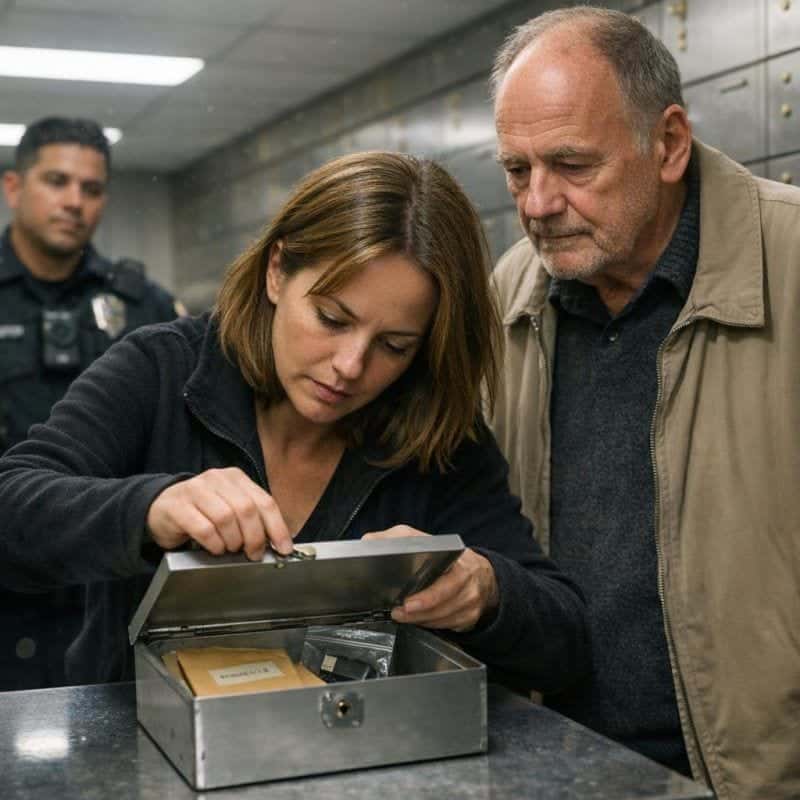
My hands shook when I inserted the key—the one Amy had found, the one that had started all of this. The lock turned smoothly, like it had been waiting. Mr. Devlin stood close enough that I could hear him breathing.
I pulled the long metal box out and set it on the table. Lifted the lid. For weeks I’d been terrified it would be empty, that this whole thing had been for nothing. But it wasn’t empty. Inside were three manila envelopes, neatly labeled with dates.
A USB drive in a plastic baggie. And on top of everything, a sealed letter with my name written across the front in Claire’s careful handwriting.

Image by RM AI
Claire’s Letter
I waited until I got home to read it. Officer Martinez had taken the envelopes and the USB drive as evidence, but he let me keep the letter. ‘Personal correspondence,’ he’d said.
I sat at my kitchen table with a cup of tea I didn’t drink and opened the envelope. Claire’s handwriting was exactly as I remembered—precise, slightly slanted. ‘Elaine,’ it began. ‘If you’re reading this, then I’m gone and you’ve found the key.
I’m sorry I couldn’t tell you any of this while I was alive. I discovered what Daniel was doing about eight months ago. He’d been forging estate documents, targeting elderly clients, working with people at the bank and in probate court.
When I found the paperwork, I realized he’d done it to our mother too. He stole from our own family, Elaine. I started collecting evidence, but I knew if he found out, he’d destroy everything. So I distanced myself. I stopped coming to dinners.
I made excuses. I needed you to believe we’d drifted apart naturally, so he wouldn’t suspect I was protecting you. I hid the evidence here and put the key in the coat—the one you never wore, the one I knew you’d donate eventually.
Someone would find it. Someone did.’ My hands were shaking so hard the paper rattled, and I finally understood why she’d disappeared from my life.

Image by RM AI
The USB Drive
Officer Martinez called me three days later. I’d been sitting in a fog since reading Claire’s letter, barely eating, not sleeping well.
He asked if he could come by, and when he showed up at my door he had a detective with him—a woman named Chen with sharp eyes and a kind voice. They sat in my living room and told me what was on the USB drive.
Scanned documents showing forged signatures. Emails between Daniel and two other attorneys coordinating which estates to target. Bank records showing money moving through shell companies.
A spreadsheet—an actual spreadsheet—listing names, dates, and amounts stolen. ‘Your sister was meticulous,’ Detective Chen said. ‘This is some of the cleanest evidence I’ve seen in a fraud case.’ Officer Martinez leaned forward.
‘Ms. Hartwell, we’re bringing charges against your son. But it’s bigger than him. The evidence shows at least four other people involved—bank employees, a probate clerk, two other attorneys. We’re moving on all of them.
‘ I nodded, feeling like I was underwater. ‘How many families?’ I asked. Detective Chen looked at her notes. ‘At least twelve we can confirm. Probably more.
‘ I thought about Claire, alone in her apartment, collecting all this evidence, knowing what it would cost.
And I thought about the families Daniel had destroyed, and I couldn’t feel anything but a grim, hollow satisfaction that he was finally going to pay.

Image by RM AI
Daniel’s Arrest
Two days later, I was folding laundry when my phone started buzzing with news alerts. I picked it up and saw Daniel’s face on the screen. ‘Local Attorney Arrested in Elder Fraud Scheme,’ the headline read.
I sat down on the couch and turned on the TV. There he was on three different channels, being walked out of his house in handcuffs. His wife stood in the doorway crying. His neighbors were recording it on their phones.
The reporters said he was being charged with fraud, forgery, conspiracy, and elder abuse. They said the investigation had uncovered a network of professionals who’d been systematically stealing from vulnerable families for years.
They used words like ‘predatory’ and ‘calculated’ and ‘betrayal of trust.’ I kept waiting to cry. I thought I’d break down, that seeing my son arrested on live television would shatter whatever was left of me.
But I just sat there, numb, watching them replay the footage over and over. He looked smaller in handcuffs. Older. Like a stranger I used to know.
I turned off the TV eventually and sat in the quiet, and the silence was worse than the news because it left me alone with the fact that I couldn’t feel anything at all.

Image by RM AI
The Other Victims
Bradley called me a week after the arrest. I’d been avoiding most calls, but I answered his. ‘Elaine, I thought you should know,’ he said. ‘Other families are coming forward. At least six so far, maybe more.
They saw the news and realized what happened to them.’ He paused. ‘Some of these cases go back years. People who thought they’d just lost estates to legal complications, bad luck, their own confusion. Now they’re realizing they were targeted.
‘ I asked him to send me the details. I don’t know why. Maybe I needed to see the full scope of what Daniel had done. That night I read through the emails Bradley forwarded. One family lost their father’s business.
Another lost a home that had been in their family for three generations. But the one that broke me was from a woman named Patricia Simmons. Her mother had died two years ago, and Daniel had handled the estate.
Within six months, the house was sold to a shell company, the proceeds disappeared, and Patricia and her brother were left with nothing. ‘We thought we’d misunderstood the process,’ she wrote. ‘We thought we’d signed the wrong papers.
We blamed ourselves. But he forged our mother’s signature and sold her house out from under us while we were still grieving.’ I closed my laptop and sat in the dark, drowning in shame.

Image by RM AI
Facing the Families
The victim advocate who contacted me was a woman named Susan. She was organizing a meeting for the families, a chance for them to connect and share resources. She asked if I’d be willing to attend.
‘They know you’re Daniel’s mother,’ she said carefully. ‘But they also know you’re the one who helped stop him. Some of them want to meet you.’ I almost said no.
The idea of facing these people, of seeing what my son had done to them, made me feel sick. But I went. The meeting was in a community center, about fifteen people in a circle of folding chairs. Susan introduced me, and the room went quiet.
A man named Robert spoke first. He thanked me for not looking away, for doing the hard thing. An older woman named Grace squeezed my hand and said I was brave. I didn’t feel brave. I felt complicit. Then Patricia Simmons spoke.
The woman whose mother’s house was stolen. She looked at me with hard eyes and said, ‘I’m glad he’s arrested. But why did it take so long? How many of us had to lose everything before someone finally stopped him?’ I didn’t have an answer.
No one in that room did. She wasn’t wrong to ask.

Image by RM AI
The Plea Deal
Daniel’s attorney called me a month after the arrest. His voice was smooth, professional, like we were discussing a business transaction. ‘Ms. Hartwell, I wanted to inform you that we’re negotiating a plea agreement.
Daniel is willing to provide testimony against his associates in exchange for a reduced sentence.’ I didn’t say anything. He continued. ‘The prosecution is offering twelve years instead of twenty-five. It’s a good deal, considering the charges.
‘ I asked what he wanted from me. ‘Nothing,’ he said. ‘But the court is accepting victim impact statements. You’re considered a victim because of the fraud involving your mother’s estate.
If you’d like to speak at the sentencing hearing, that’s your right.’ After he hung up, I sat with the phone in my lap for a long time. Ruth called later that day. ‘You don’t have to do this,’ she said.
‘No one expects you to stand up there and talk about your own son.’ But I kept thinking about Patricia’s question. Why did it take so long? Maybe because I hadn’t wanted to see. Maybe because I’d made it too easy for him.
I didn’t know if I could face him in court. I didn’t know if I had the strength to say any of it out loud.

Image by RM AI
In the Courtroom
I decided to go to the sentencing hearing, but I didn’t prepare a statement. I sat in the back row of the courtroom with Ruth beside me. Other families were there—Patricia, Robert, Grace, people whose lives Daniel had destroyed. Some of them spoke.
Patricia’s voice shook when she described losing her mother’s house. Robert talked about his father’s business being stolen. Grace cried. The judge listened to all of it with a face like stone.
When it was my turn, the bailiff called my name, and I stayed seated. Ruth squeezed my hand. I shook my head. I had nothing to say that would matter, nothing that would undo what he’d done. The judge sentenced him to twelve years.
Daniel stood when they read it, his shoulders tight, his lawyer beside him. And then, just before they led him away, he turned and looked at me. Our eyes met across the courtroom.
I wanted to see the man he’d become—the one who’d lied and stolen and destroyed families. But all I saw was the boy I’d raised. The one who used to fall asleep on my lap. The one I’d loved before I knew who he really was.
And it broke my heart all over again.

Image by RM AI
The Sentence
The judge didn’t rush. She read through her notes, adjusted her glasses, and looked down at Daniel standing at the defense table. His lawyer stood beside him, hands folded. The courtroom was silent except for someone coughing in the back row.
I could hear my own heartbeat. The judge talked about the scale of the fraud, the number of victims, the breach of trust. She mentioned Claire’s name once, briefly, and I felt my chest tighten. Then she said eight years.
Eight years in federal prison, followed by supervised release. Restitution to be determined but likely in the millions. Daniel didn’t react at first. He just stood there, staring straight ahead.
His lawyer touched his arm, said something I couldn’t hear. The bailiff moved toward them, ready to take him into custody. And then, just before they led him away, Daniel turned.
He looked back over his shoulder, scanning the courtroom until he found me. Our eyes locked. I could’ve looked down, could’ve turned away like I’d done so many times before. But I didn’t.
I held his gaze and let him see everything—my anger, my grief, my love, all of it. And then they took him, and he was gone.

Image by RM AI
Returning to Normal
I went back to work the following Monday. Same desk at the library, same stack of books to reshelve, same patrons asking where to find the large-print mysteries. Ruth brought me coffee during my break, and we sat in the staff room like we always did.
I made grocery lists. I went to church and folded bulletins for Sunday service. I watered my plants and paid my bills on time. Everything looked normal from the outside. But it wasn’t.
I’d catch myself staring at nothing in the middle of folding laundry, thinking about Claire’s letters or Daniel’s face in that courtroom. I’d lose track of conversations, realize someone had asked me a question twice.
At night, I’d lie awake and replay moments—finding the key, reading the documents, watching Daniel led away in handcuffs. People kept telling me I’d get back to normal eventually, that time would make it easier. But I knew the truth.
I wasn’t going back to who I was before I donated that coat. That version of me—the one who didn’t ask questions, who trusted easily, who believed her son without hesitation—she was gone. And honestly, I wasn’t sure I wanted her back anyway.

Image by RM AI
A Letter to Claire
I wrote the letter on a Tuesday evening, sitting at my kitchen table with a cup of tea going cold beside me. ‘Dear Claire,’ I started, and then the words just came.
I thanked her for protecting me all those years, for keeping the evidence hidden where Daniel would never find it, for loving me enough to carry that burden alone.
I apologized for not seeing what was happening, for being blind to the truth even when it was right in front of me. I told her I understood now why she’d done it, why she couldn’t tell me while she was alive.
I said I forgave her, even though there was nothing to forgive. I wrote that I missed her. That I wished we’d had more time. That I hoped, wherever she was, she knew I finally understood. When I finished, I read it through twice.
My handwriting looked shaky in places. Then I folded the letter carefully, walked to the kitchen sink, and held it over the drain. I lit a match and touched it to the corner of the paper.
The flame caught quickly, crawling up the edge, turning the words to ash. I watched it burn until there was nothing left but black fragments swirling down the drain, and I felt something inside me lift and float away with the smoke.

Image by RM AI
The Coat I’ll Never Forget
It was six months later when I saw her. I was at the grocery store, pushing my cart past the produce section, when a woman walked by wearing a camel-colored coat. Not my coat—this one was newer, different buttons, different cut.
Returning to Normal
I went back to work the following Monday. Same desk at the library, same stack of books to reshelve, same patrons asking where to find the large-print mysteries. Ruth brought me coffee during my break, and we sat in the staff room like we always did.
I made grocery lists. I went to church and folded bulletins for Sunday service. I watered my plants and paid my bills on time. Everything looked normal from the outside. But it wasn’t.
I’d catch myself staring at nothing in the middle of folding laundry, thinking about Claire’s letters or Daniel’s face in that courtroom. I’d lose track of conversations, realize someone had asked me a question twice.
At night, I’d lie awake and replay moments—finding the key, reading the documents, watching Daniel led away in handcuffs. People kept telling me I’d get back to normal eventually, that time would make it easier. But I knew the truth.
I wasn’t going back to who I was before I donated that coat. That version of me—the one who didn’t ask questions, who trusted easily, who believed her son without hesitation—she was gone. And honestly, I wasn’t sure I wanted her back anyway.
Image by RM AI
A Letter to Claire
I wrote the letter on a Tuesday evening, sitting at my kitchen table with a cup of tea going cold beside me. ‘Dear Claire,’ I started, and then the words just came.
I thanked her for protecting me all those years, for keeping the evidence hidden where Daniel would never find it, for loving me enough to carry that burden alone.
I apologized for not seeing what was happening, for being blind to the truth even when it was right in front of me. I told her I understood now why she’d done it, why she couldn’t tell me while she was alive.
I said I forgave her, even though there was nothing to forgive. I wrote that I missed her. That I wished we’d had more time. That I hoped, wherever she was, she knew I finally understood. When I finished, I read it through twice.
My handwriting looked shaky in places. Then I folded the letter carefully, walked to the kitchen sink, and held it over the drain. I lit a match and touched it to the corner of the paper.
The flame caught quickly, crawling up the edge, turning the words to ash. I watched it burn until there was nothing left but black fragments swirling down the drain, and I felt something inside me lift and float away with the smoke.
Image by RM AI
The Coat I’ll Never Forget
It was six months later when I saw her. I was at the grocery store, pushing my cart past the produce section, when a woman walked by wearing a camel-colored coat. Not my coat—this one was newer, different buttons, different cut.
But for a second, my heart stopped. I thought about Claire wearing that coat through winters I couldn’t remember, about the key sewn into the lining, about all the secrets we carry in our pockets and our closets without even knowing.
The woman disappeared around the corner toward the dairy aisle, and I stood there holding a bag of apples, smiling like an idiot. Because the coat didn’t haunt me anymore. It was just a coat. And the key was just a key.
And Claire had done what she thought was right, and Daniel had done what he’d chosen to do, and I’d survived all of it. I finished my shopping, loaded the bags into my car, and drove home through streets I’d driven down a thousand times before.
The sun was setting, turning everything gold. And for the first time in what felt like forever, I recognized the woman looking back at me in the rearview mirror—older, wiser, and finally, finally free.

Image by RM AI